
Quantum computing is an emerging technology with great promise accompanied by growing threats to cybersecurity. In this article we will explain cryptographic vulnerabilities and subsequent steps to safely navigate the post-quantum era.
DISCLAIMER: This information is provided for educational and informational purposes only. By using this material, you acknowledge and agree to assume full responsibility for the risks and damages that may arise from your actions. HiDi Corporation is not responsible or liable for any errors, omissions, or outcomes from the use of this information. Please consult HiDi Corporation directly for professional advice on your cryptographic security needs.
Cryptography is a necessary tool for securing computers and data, both in the context of physical access and cybersecurity. The security of cryptographic schemes is built around computational problems that are extremely difficult for even the largest supercomputers to solve.
The 4 Cryptography Tasks
Cryptography has 4 core tasks: confidentiality, integrity, authentication, and non-repudiation.
Confidentiality
Integrity
Protect data from unauthorized access
Detect data tampering or corruption
Authentication
Non-repudiation
Verify the identity of an entity
Authenticated proof of an action/transaction
The 3 Cryptography Primitives
The 4 cryptographic tasks mentioned above can be carried out through a combination of three primitives: hash functions, symmetric encryption, and asymmetric encryption. The table below summarizes their operations, tasks, useful features, what makes them secure, and their level of vulnerability to quantum computers.
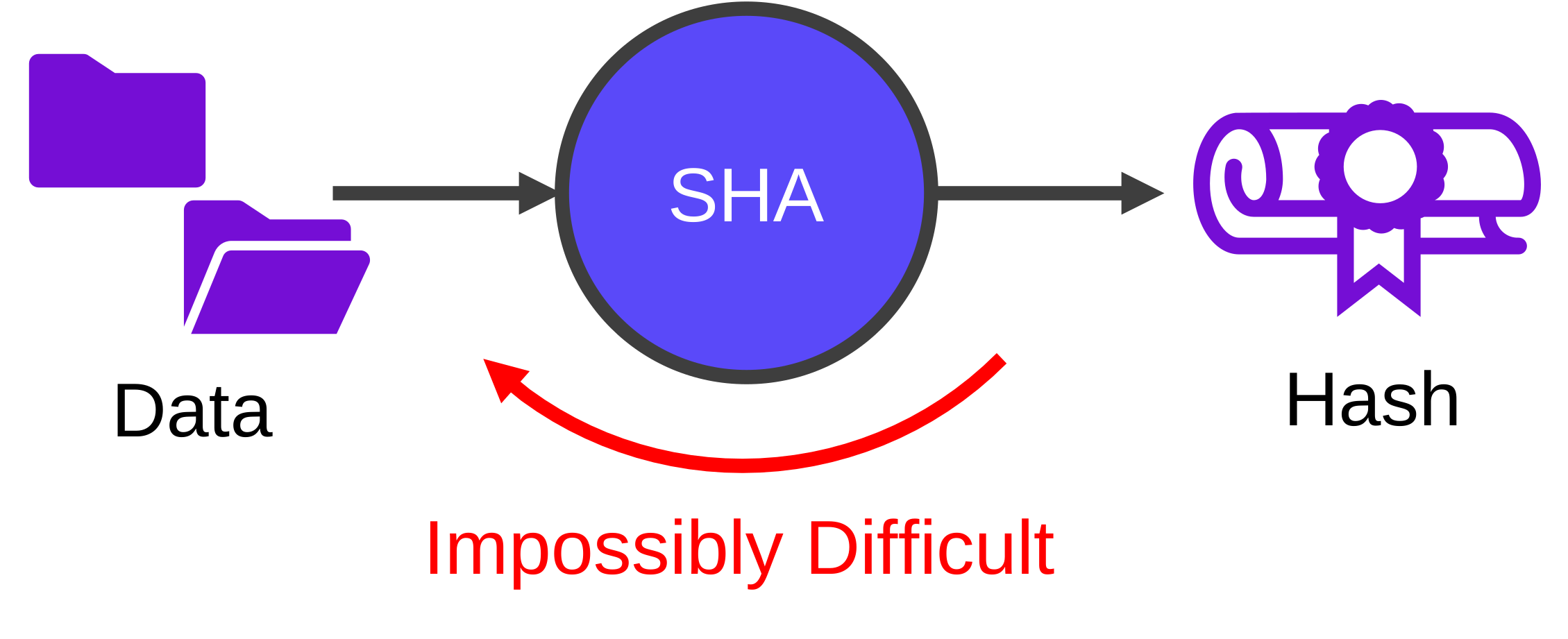
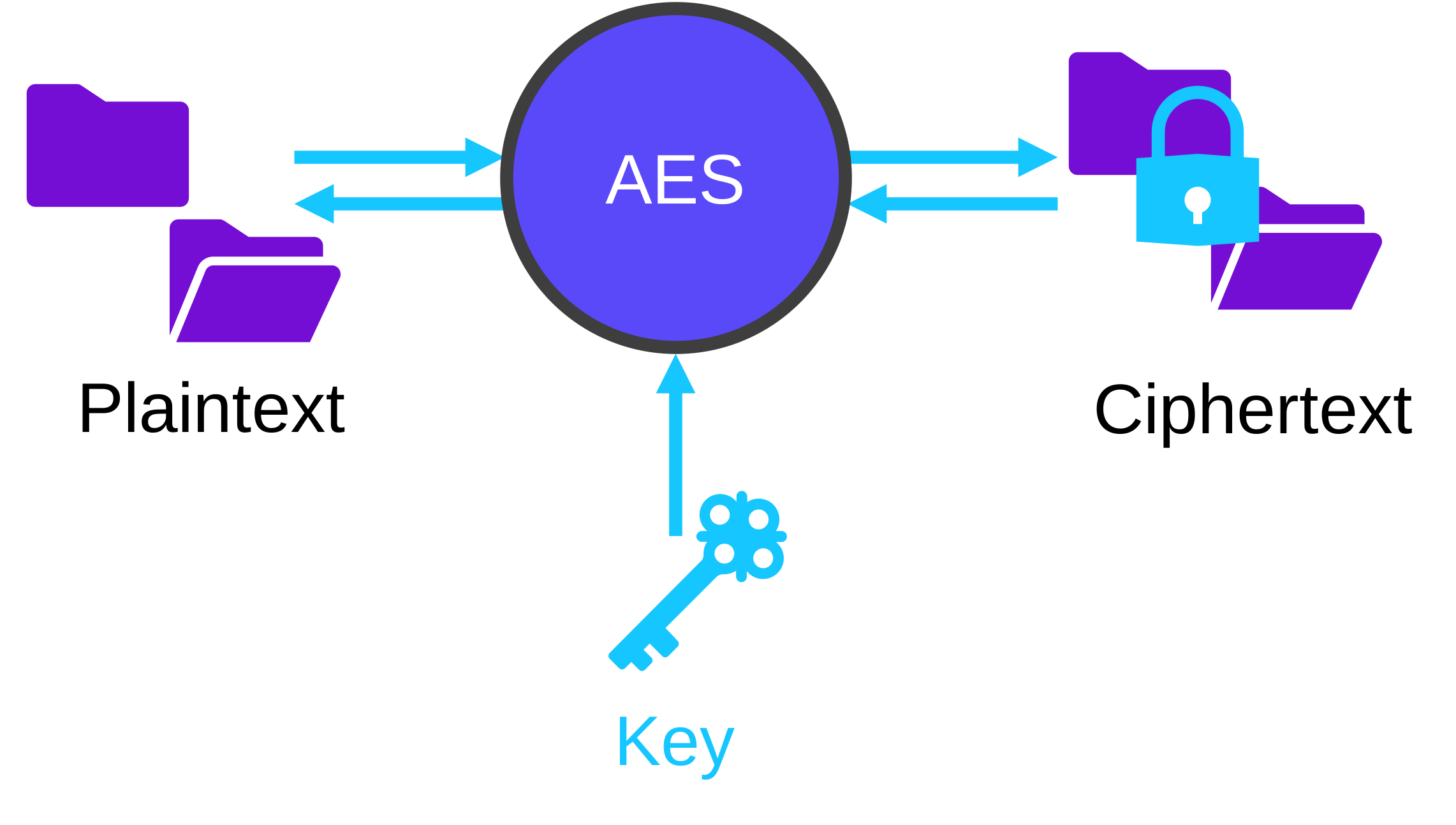
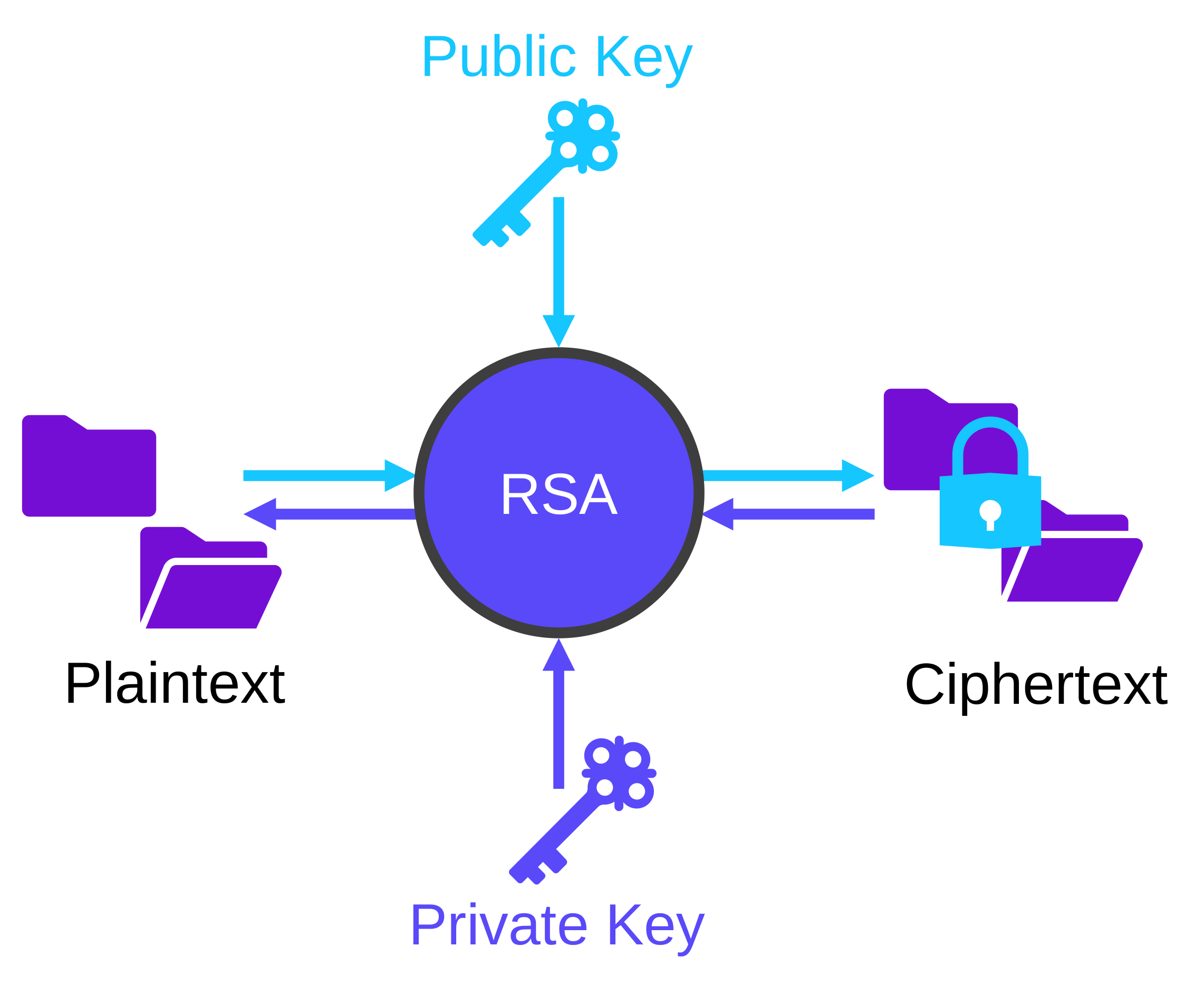
| Hash Functions | Symmetric Key Encryption | Asymmetric Key Encryption | |
| Keys | No keys | One secret key | Two keys: public and private |
| Task | Compute a fixed-length hash string from arbitrary data | Encrypt-decrypt data between plaintext-ciphertext with a key | Establish security between two entities without a predetermined key |
| Useful Feature | Computation of the hash string is repeatable | Ciphertext bears no resemblance to plaintext | Various schemes to encrypt/decrypt, sign, or verify data |
| Security | Generating data to match a bitstring is infeasible | Guessing the key from plaintext and corresponding ciphertext is infeasible | Decrypting or signing data without the private key is infeasible |
| Quantum Vulnerability | Low | Low | High |
The tasks and primitives are covered in detail in our tutorial on breaking cryptography using quantum computers.
Vulnerabilities
All three primitives are vulnerable to attack from quantum computers. The threat to hashing and symmetric cryptography is relatively benign with simple fixes. Unfortunately, asymmetric encryption requires a complete overhaul of public key infrastructure. Establishing secure connections over the internet, e.g. using HTTPS or TLS, is one of the most common application of asymmetric encryption.
Adversaries are already intercepting and archiving encrypted communications, intellectual property, and financial records to harvest now, decrypt later. Once fault-tolerant quantum systems reach operational scale, this harvested data will be vulnerable. If the window of time during which your data must remain is longer than 2-3 years, it is imperative to begin the transition to post-quantum cryptography protocols immediately. The encryption protocols protecting your data today will not protect it once large-scale fault-tolerant quantum computers are available.
Strategic Action Plan
- Task Force
Designate a team or individual in your organization to lead the PQC migration effort. Assess the capabilities of your organization to decide whether your organization requires new hires, employee training, or external consultants. - Cryptographic Asset Inventory
Perform a top-down inventory of all cybersecurity elements in your organization. Document all certificates, key stores, legacy systems, and third-party dependencies. Identify where vulnerable protocols like RSA, ECC, and Diffie-Hellman are still in use. - PQC Migration Rollout
Begin transition to post-quantum cryptography (PQC) standards: NIST FIPS 203/204/205 for key exchange and digital signatures. Plan hybrid deployments during the transition window. Hybrid protocols combine both conventional and PQC protocols. PQC standards require more computational resources; your infrastructure may need hardware upgrades. - Set Deadlines to Ensure Compliance
Executive order 14412 has established the following important deadlines:- “… transition all HVAs [high value assets] and high impact systems to use PQC for key establishment by December 31, 2030“
- “… transition all HVAs and high impact systems to use PQC for digital signatures by December 31, 2031“
- “… proposed rule amending the Federal Acquisition Regulation (FAR) to require covered contractors to comply by December 31, 2030“
Make sure your organization is prepared to meet any compliance requirements. Further compliance requirements are expected for industries handling sensitive information, e.g. banking and healthcare.
- Upgrade Symmetric Encryption & Hashing
Implement AES-256 and SHA-512 across high-security environments for an extra layer of security. This may also require hardware upgrades. - Strengthen Cryptographic Randomness
For high security applications consider replacing deterministic software-based pseudo-random number generators (PRNGs) with hardware-based Quantum Random Number Generators (QRNG) to eliminate seeding predictability. - Monitor QKD Infrastructure
Appropriate resources to prepare for integration with quantum networks, and an eventual transition to quantum key distribution (QKD). Evaluate quantum network readiness for future hybrid security models.
Quantum readiness is a multi-year engineering and governance challenge. Firmware updates, certificate rotation, supply chain coordination, and legacy system decommissioning must be carefully rolled out and warrant a long transition period. For a technical deep dive into how Shor’s and Grover’s algorithms break classical cryptography, see our companion tutorial: Breaking Cryptography with Quantum Computers: A Tutorial.
DISCLAIMER: This information is provided for educational and informational purposes only. By using this material, you acknowledge and agree to assume full responsibility for the risks and damages that may arise from your actions. HiDi Corporation is not responsible or liable for any errors, omissions, or outcomes from the use of this information. Please consult HiDi Corporation directly for professional advice on your cryptographic security needs.
© 2026 HiDi Corporation. All rights reserved.